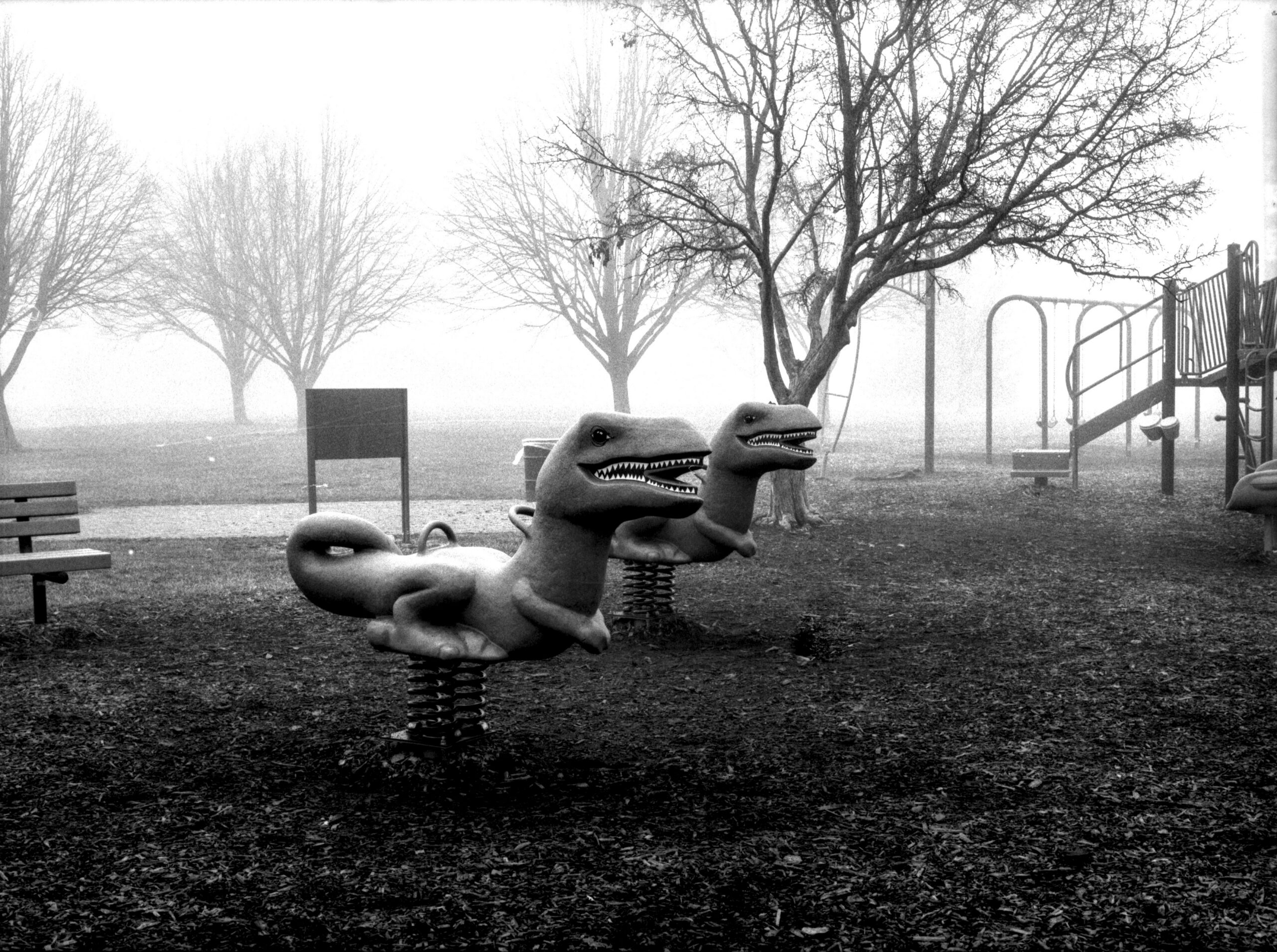
A dense fog advisory goes out, and most people drive more carefully. Photographers open the door and listen.
Fog changes a morning twice — first what you see, then what you hear. The visual part is obvious: colors mute, contrast flattens, distance dissolves. But the sound is the half people forget. On a foggy morning the playground down the street is silent. The football field, which on any given Friday echoes with cheers and whistles and a PA announcer, holds nothing. Sound attenuates in fog the way light does — absorbed, muffled, gone. What remains is the quiet underneath everything: your own footsteps, your own breathing.
It’s probably the closest we get to black and white in nature. Not just in appearance — in experience. The fog removes color from the world and sound from the air, and what’s left is the same stripped-down monochrome that a red filter and Kodak film have been giving photographers for a century.
I’ve been chasing this. Five years ago, on a March morning even thicker than anything since, I carried the Pentax 645 through fog so dense that the world existed only in the nearest thirty feet. The frame above is my favorite from that morning — the playground with its dinosaur spring riders, empty, dissolving into the white. Extinct creatures from an extinct era, standing in a whiteness that erased everything behind them. It felt like the fog had rolled back time itself.
This September, the fog returned
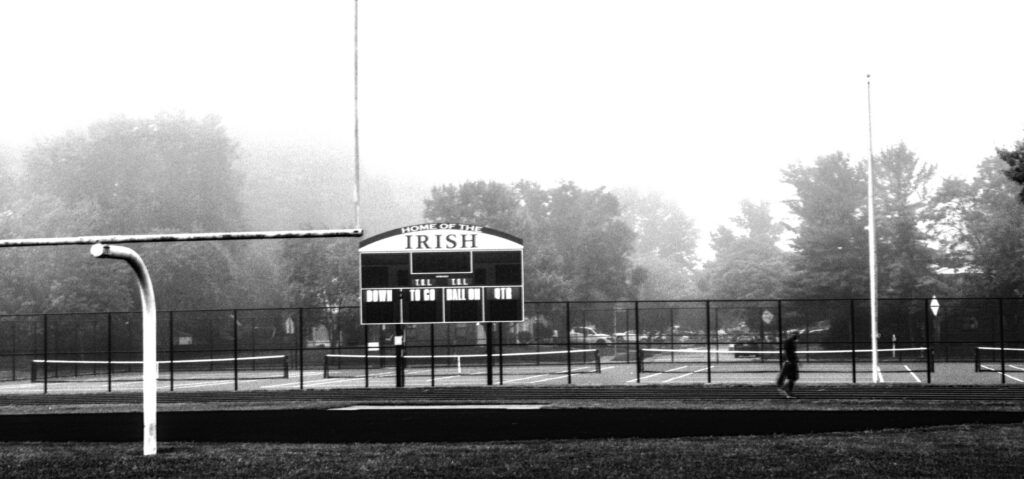
A dense fog advisory on a Sunday morning. By 8 AM I was at the middle school track near our house, Acros II film in the 645, metering for the shadows and adding a stop and a half — fog fools meters into underexposing, and I wanted the fog to render white, not gray.
A lone runner appeared on the track, moving through the gray layers. His dark shirt and shorts — contrasting with the white fog, floating between the dark trees and the white air. He circled the field while I circled him, and the fog kept rearranging the distance between us: one lap he was a silhouette, the next he was nearly gone, the next he emerged again.
The T-Rex frame above is from that 2021 morning — the spring riders at the playground, standing empty in the whiteout. I shot it because extinct creatures in dense fog felt like a photograph from a world that had already ended. It’s still my favorite from that shoot.
The development
Fog negatives are flat. The scene has no deep shadows and no true whites — everything compresses into the middle. So this roll got the Zone System treatment: N+1 development, one extra stop of contrast, in Kodak T-Max Developer. (If you are a photographer and are unfamiliar with the Zone system, check out Ansel Adams 3 books– The Camera, The Negative, and The Print. They can be quite technical, but you will get an understand of the power of his system and how you can use it to make great images.)
The math: normal development is about 7 minutes; N+1 stretches that to roughly 9:45. The fog values in the negative climbed a full zone while the silhouettes stayed put. On the scan, the fog whites that would have printed as weak gray now hold real structure — and where the brightest fog still clipped past what the sensor could hold, the Zone Equalizer pulled those top zones down on the scan until the fog had gradation instead of a flat white sheet. The standard deviation in the sky tripled. That’s not an accident of processing; that’s placement and control, the whole Zone System, working digitally.
What I learned
Fog teaches the same lesson every time, and I relearn it every few years: the photograph is in what’s missing. The missing color. The missing distance. The missing sound. On that playground five years ago, and on this track last week, the absence was the subject. The fog doesn’t hide the world — it simplifies it down to what matters.
And it never lasts. By 10 AM the sun had burned through, the colors came back, the sounds came back, and the world was loud and colored again. Which is, I suppose, why we photograph it.
Camera: Pentax 645 NII
Lens: 75mm
Film: Fujifilm Neopan Acros II 100
Development: Kodak T-Max Developer 1+4, 20°C, N+1 (~9:45)
Scanning: Epson V850 Pro, wet-mounted
Location: Olde Sawmill area, Dublin, Ohio
Captured: September 13, 2026 (fog frames); March 17, 2021 (playground anchor)
Leave a Reply